With more than two hundred species distributed from California through Texas and across most of mainland Mexico, Central and South America, and islands in the Caribbean Sea, the Phyllostomidae bat family (American leaf-nosed bats) is one of the world's most diverse mammalian families. From an insectivorous ancestor, species living today, over about 30 million years, have evolved a hyper-diverse range of diets, from blood or small vertebrates, to consuming nectar, pollen, and fruit. Phyllostomid plant-visiting species are responsible for pollinating more than five hundred species of neotropical shrubs, trees, vines, and epiphytes--many of which are economically and ecologically important--and they also disperse the seeds of at least another five hundred plant species. Fruit-eating and seed-dispersing members of this family thus play a crucial role in the regeneration of neotropical forests, and the fruit eaters are among the most abundant mammals in these habitats.
Coauthored by leading experts in the field and synthesizing the latest advances in molecular biology and ecological methods, Phyllostomid Bats is the first overview in more than forty years of the evolution of the many morphological, behavioral, physiological, and ecological adaptations in this family. Featuring abundant illustrations as well as details on the current conservation status of phyllostomid species, it is both a comprehensive reference for these ecologically vital creatures and a fascinating exploration of the evolutionary process of adaptive radiation. 512 pages, 9 color plates, 46 halftones, 23 line drawings, 33 tables | 8-1/2 x 11. 2011. Edited by Theodore H. Fleming, Liliana M. Davalos, and Marco A. R. Mello.
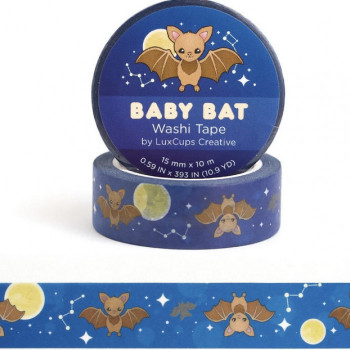
One roll of decorative washi tape. This super cute and eco-friendly paper tape is perfect for journals, planners, gift swapping, and snail mail, of course.
Details: o 15mm x 10m (0.59in x 393 in) o Light repositionable adhesive o Leaves no sticky residue o Can be torn by hand o Writable surface
Other ideas for using washi tape: Notecards, GiftTags, Scrapbooking, Bullet Journals, Organizing Labels, Cable Markers, Greeting Cards, Page Markers, Watercolor Masking, you get the idea! It's amazingly versatile.
Silent nocturnal sentinels, ever present at your side. Delicate yet striking, perfect for every day wear. A petite pair of flying bat, pewter dropper earrings suspended from a fine chain. On surgical steel ear-wires. Complimentary pendant is a small pewter flying bat with outstretched wings on an 18 inch chain. Approximate Dimensions: H: 13mm (0.51") W: 27mm (1.06") D: 7mm (0.28") Weight: 8g (0.28oz) Materials: Pewter
This comprehensive introduction to bats and bat study features accounts for 23 species of bats known from Oklahoma. Each includes the latest information about distribution, with both Oklahoma- and North America-wide range maps, conservation status, identification, natural history, and echolocation call characteristics. This richly illustrated resource has species identification keys for both eastern and western Oklahoma, owing to the state's rich beat fauna thanks to diverse habitat resources and its south-central location in the U.S. Though written from a state perspective, the book will be a valuable resource to both eastern and western bat-workers alike, especially those hailing from regions lacking current resources of this sort. Soft-cover, perfect bound, 100 pages.
By Emily Davis. 73 by 59 inches. Featuring a star block border and bats embroidered throughout. A variation of the Bat Scramble using traditional Amish colors and style.
Stuck home and not travelling to events because of the pandemic, Batgoods.com owner Emily Davis has been spending a great deal of time in her sewing room finding interesting and new patterns, unused fabrics in the stash and creative ideas to work with. The result has been some unusual and original designs.
By Emily Davis. 63 by 79 inches. Featuring a diamond block border and bats embroidered throughout.
Stuck home and not travelling to events because of the pandemic, Batgoods.com owner Emily Davis has been spending a great deal of time in her sewing room finding interesting and new patterns, unused fabrics in the stash and creative ideas to work with. The result has been some unusual and original designs.
By Emily Davis, 2021. This quilt is an homage to bats using a most unusual landscape, emerging from rocky retreats into a night sky. From Maine to Montana, threatened, endangered and other rarely seen species of bats have been found to be using rocky talus for hibernation or torpor during overwintering and as useful refuges seasonally and during migration. This exciting bat habitat is just being understood as ongoing studies by researchers expand documention of this behavior. Numerous species of bats across the U.S. are believed to use talus slopes as habitat. Most notably Eastern Small-footed Bats are known to have a preference for the loose, rocky slopes. Fabrics with bats and rocky geology merge in pieced blocks and with a star design to create an impression of these fleeting encounters of stones, sky and our beloved bats. Finished with a flowing quilting design to lend movement.
An intricate maxtrix of patchwork comprised of bat, insect and star fabrics. Bats in the quilting finish the picture. Top image is quilter Emily Davis showing off the quilt at the 2019 Western Bat Working Group meeting in Tulsa, Oklahoma.
An original piece inspired by a series of Tula Pink fabrics featuring bats. The quilt was designed to represent a stone walled garden environment with bats hunting moths hiding throughout. Looking closely, one will see bats in the quiltwork as well. Much as in our natural world, bats are all around us, but not so easy to see..
By Emily Davis. 2022. 75 by 75 inches. This quilt started as round robin quilt guild challenge, with each round being a specific style or theme...flying geese, buidlings, stars, and so forth. The bat theme emerged to show bats in a rurral environment using farm buildings as roosts flying over impressions of fields and water using blue and green topo map fabric.